



The state’s health sector was expected to lose more than $3.5 billion this year as a result of the expiring subsidies, as uninsured patients forgo care or show up in emergency rooms but can’t pay. Getty Images.
More than half a million Georgians have dropped health insurance coverage amid stiff premium price hikes for federally subsidized Affordable Care Act plans, according to data obtained by The Current GA and the Georgia Recorder.
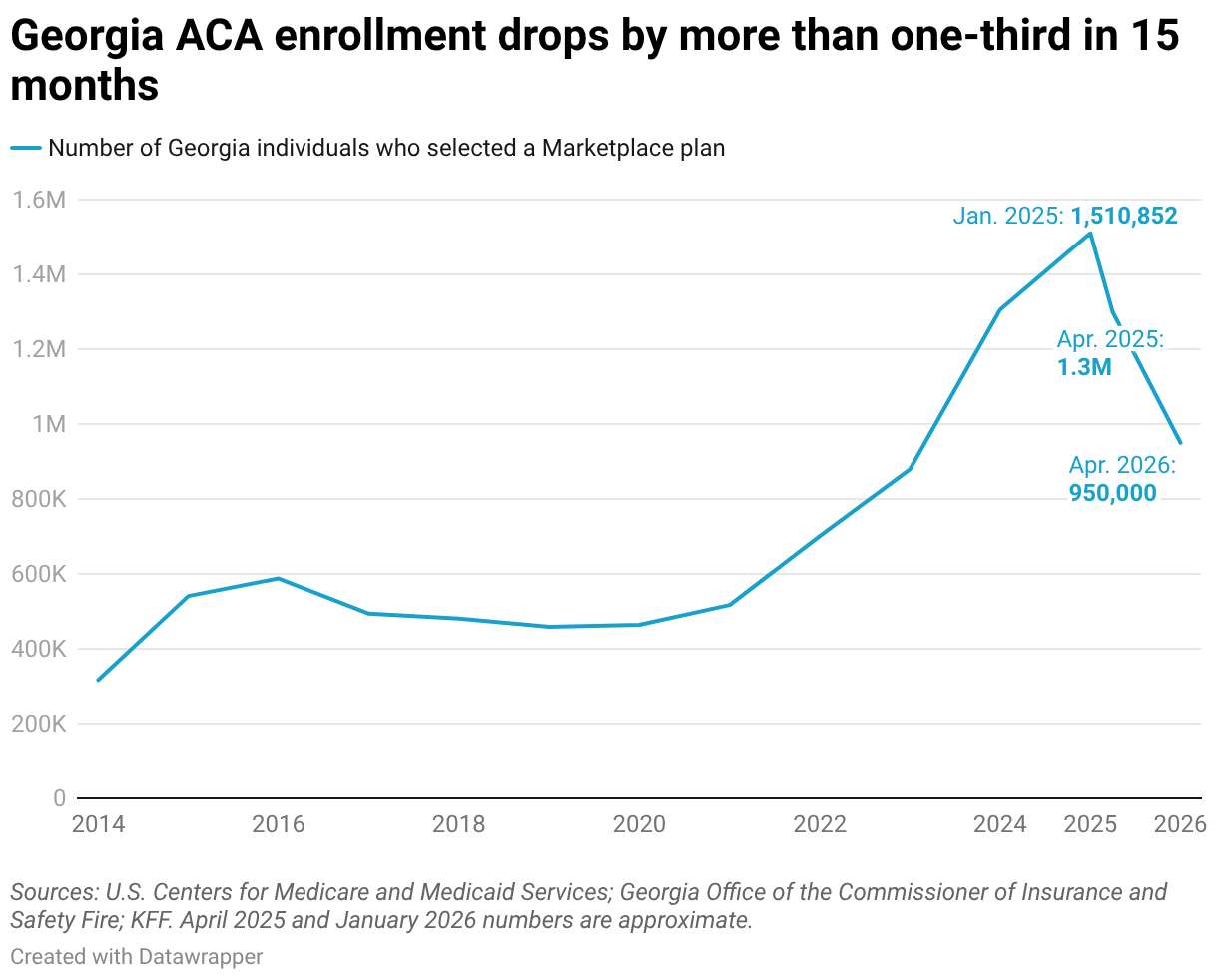
The 37% enrollment drop – from 1.5 million Georgians in January 2025 to 950,000 as of April 17, 2026 — dwarfs any previous decline in the state since the launch of so-called Obamacare health insurance plans in 2014.
Rising prices for health insurance policies bought on Georgia’s health care marketplace occurred after the U.S. Congress and President Donald Trump decided against extending Covid-era “enhanced” health insurance subsidies, which sunset Dec. 31, 2025.
Preliminary data released in January about the number of Georgians enrolled in ACA plans hinted at a sizable decline of 190,000. The more complete numbers have been adjusted after those people who had been reenrolled automatically at the start of 2026 failed to make their first premium payments.
The Georgia Office of the Commissioner of Insurance and Safety Fire released the data to The Current following a public records request. It will be reported by the federal government this summer.
The steep decline sparked immediate concern from the organization that advocates for Georgia’s rural hospitals about the financial viability of these vital institutions should the data signify that Georgia’s uninsured rate has soared after years of edging down.
THE HISTORY, FACTORS
The Affordable Care Act was passed in 2010 and the Marketplace launched in 2014. Under the ACA, the federal government mandates basic levels of care such as for prescriptions, mental health and maternal care; and it also subsidizes premiums for certain income groups. Georgia also began its own subsidies in 2022. Starting with 2025 coverage, Georgia took over the ACA enrollment system at GeorgiaAccess.gov.
Factors influencing whether the numbers of enrollees rise or fall have included how well the system is operating, how much outreach and enrollment assistance the government enacted, and above all, how expensive coverage was. President Trump in his first term pulled back on enrollment assistance, and in his second term has allowed massive pandemic-era subsidies to expire.
“I don’t know what we’re going to do, honestly” said Monty Veazey, president of the Georgia Alliance of Community Hospitals, when informed of the data by The Current. “It’s a larger number than I anticipated,” he said about the enrollment drop.
He said he was meeting with Gov. Brian Kemp next week and hoped to ask for his plans.
Drop negates recent achievements
Kemp came to office in 2019 promising to tackle Georgia’s adult uninsured rate, one of the highest in the nation. He has touted changes he oversaw to the state’s insurance market as well as the rollout of a state-based ACA marketplace called Georgia Access as solutions to this problem.
The new enrollment figures, however, raise questions about how durable those gains will be. Both Kemp and Insurance Commissioner John King did not comment on the enrollment figures.
Georgia’s enrollment drop dwarfs many other states’, according to partial ACA enrollment data first reported last week by the Wall Street Journal.
Fluctuations in enrollment for so-called marketplace plans are routine. But year over year comparisons for April also project a stark picture. In April 2025, enrollment in Georgia’s marketplace plans had already dipped to 1.3 million, according to state officials. The April 2026 data still represents a 27% drop from that level.
“It’s a really large shift in the market,” said Emma Wager, a senior policy analyst on the ACA at the health research nonprofit KFF.
There is currently no data showing whether the Georgians who dropped their marketplace insurance are now completely uninsured, or whether they took up a new kind of insurance. Some of those previously enrolled could have gotten new jobs with employer-sponsored health care, but it’s likely large numbers of them had no better options, said health policy researchers.
In general, said Matt McGough, a policy analyst at KFF, people relying on Obamacare plans “really have nowhere else to turn.”
Wager, who emphasized that she herself had not seen the latest Georgia enrollment figures, said if the result in disenrollment ends up with a spike in the uninsured rates, then hospital finances across the state will be affected.
“A larger uninsured population means that hospitals have to provide more uncompensated care. And we also know that people who are uninsured are more likely to delay or forgo medicare care…they may have severe needs by the time they actually see a doctor.”
Georgia has traditionally had among the three worst uninsured rates, along with Texas and Oklahoma. But lower premium prices during the pandemic helped lead to a surge of Georgia patients getting insured.
U.S. lawmakers including former Rep. Marjorie Taylor Greene said that Congress’s decision last year to allow extra subsidies to expire would put insurance out of reach for many. Extending the enhanced subsidies another 10 years would have cost $350 billion.
Democrats in Congress shut down the federal government last fall in a fight over the health insurance subsidies, but Congress did not renew the funding.
Since those extra subsidies expired, Georgians who make above a certain amount— around $64,000 for a single person — no longer get any federal assistance and must pay the full market price for health insurance. For some Georgians, the cost of premiums more than tripled.
Health providers expect hit
The loss of enrollment will send shock waves through Georgia’s health care industry. The state’s health sector was expected to lose more than $3.5 billion this year as a result of the expiring subsidies, as uninsured patients forgo care or show up in emergency rooms but can’t pay.
Georgia’s expected loss of health sector revenue from that change would be among the three largest in the nation, behind only Florida and Texas, according to the study by the Robert Wood Johnson Foundation and the left-leaning Urban Institute.
Dr. Ben Spitalnick, a Savannah pediatrician, said the premium hikes presented a budget crisis for some of his patients’ parents.
“I know patients who, this year it’s doubled for them,” Spitalnick said. “It’s insane to consider having to drop your health insurance,” he said. “If you’re, sort of solo employed or a very small business, and don’t have the comfort of either Medicaid or have a very large employer who has a large health plan, the exchange was a great option. Now it’s super expensive.”
McGough, the KFF researcher, said the ACA tends to insure people who are juggling hourly jobs or are self employed. Self employed often means doing gig work like driving Uber. More than a quarter of farmers and beauticians were insured through the ACA marketplace as of 2023, according to KFF.
The Affordable Care Act was passed in 2010 and the Marketplace launched in 2014. Under the ACA, the federal government mandates basic levels of care such as for prescriptions, mental health and maternal care; and it also subsidizes premiums for certain income groups. Georgia also began its own subsidies in 2022. Starting with 2025 coverage, Georgia took over the ACA enrollment system at GeorgiaAccess.gov.
Factors influencing whether the numbers of enrollees rise or fall have included how well the system is operating, how much outreach and enrollment assistance the government enacted, and above all, how expensive coverage was. President Trump in his first term pulled back on enrollment assistance, and in his second term has allowed massive pandemic-era subsidies to expire.
This story was published in partnership with The Current. The Current is an independent, in-depth and investigative journalism website for Coastal Georgia.


