


Another year, another seder—maybe one of the only such ceremonies held last Saturday evening in North Georgia.
The official date for the Jewish ceremonial meal that kicks off Passover—the Jewish festival of freedom—was Wednesday, April 1st.
But Congregation Shalom B’Harim in Gainesville has its meal and ceremony on Saturday evening, later in the eight-day holiday, to allow individual families to celebrate at their own family events before the communal one.
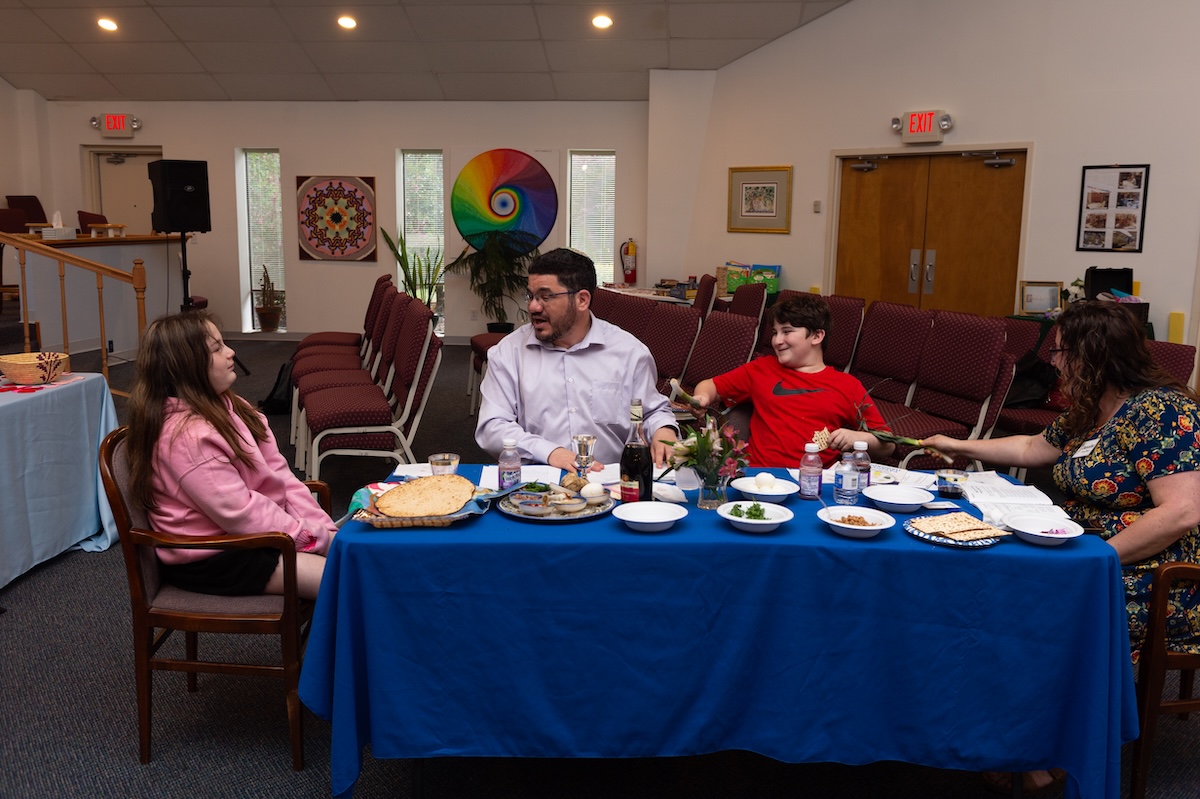
This year, the group event fell on April 4th, and some 33 congregants gathered at the synagogue, in the space it rents from a church, Unity of Gainesville, for the meal involving food, songs, and prayers unique to the holiday.
Go Down, Moses
Rabbi Matan Peled, a native Israeli, began the event with a song borrowed from a different culture–the Black spiritual, “Go Down, Moses.” The song, which first surfaced in the late 1800s, was composed by Blacks, drawing a parallel between American slavery and the enslavement in Egypt of the ancient Hebrews. Harriet Tubman, who freed many of her fellow former enslaved Blacks, was known as “Moses,” to some of abolitionist supporters and helpers.
“Tell old Pharoah, to let my people go,” the congregants sang.
The synagogue congregants, who ranged in age from pre-teens to octogenarians, took turns reciting from the Hagaddah—literally, the “telling,” the book that guides the Passover service.
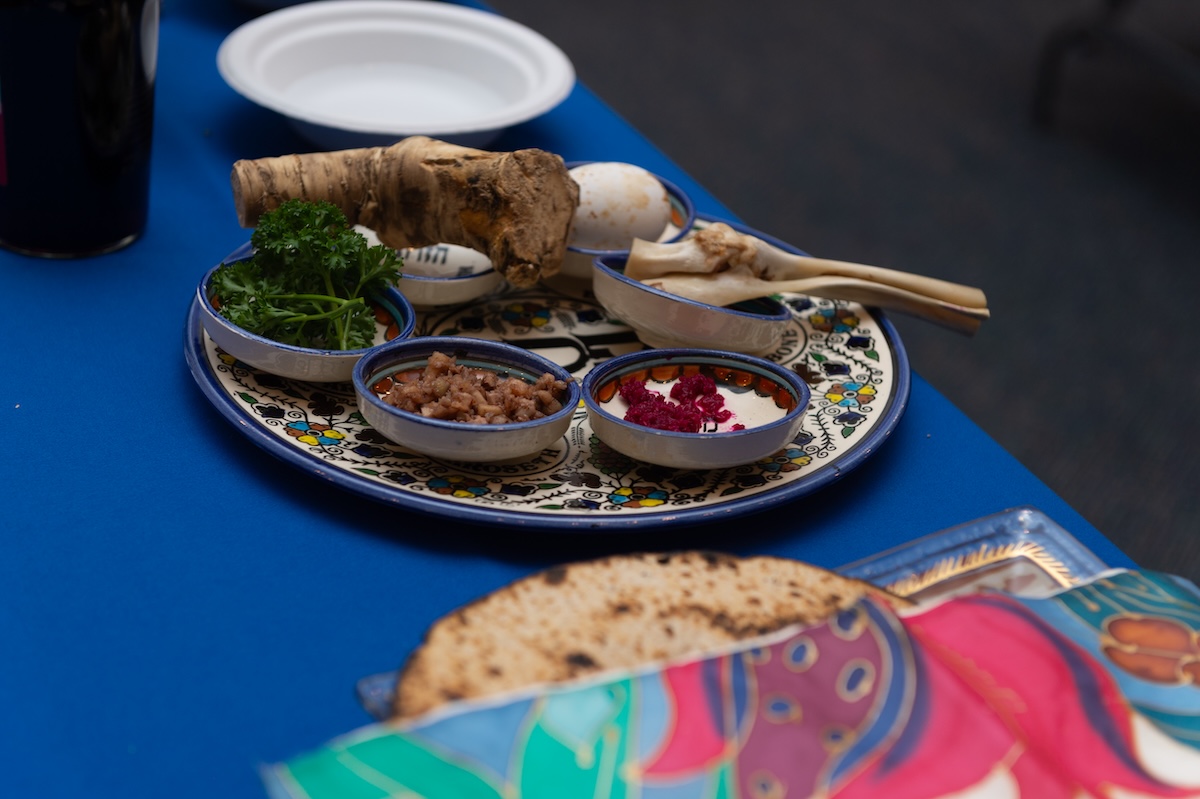
The ceremonial meal is one of the most-observed Jewish rituals by the 15 million Jews around the world and some 6 million in America. The seder includes such special foods as the flattened, unleavened bread called matzo, the sweet apple and nut mixture called charoseth, and “maror,” a combination of beets and pungent horseradish. Each symbolizes a different aspect of the Hebrew period slavery in ancient Egypt and subsequent liberation at the hands of Moses and Aaron, as described in the Biblical book of Exodus.
The group took turns reading and leading songs, with most of the words in English, some in Hebrew, and a few in Aramaic, the common language of Jews and others in the years between 90 B.C.E. and 170 C.E., when the Haggadah was compiled.
A Jewish-Christian Connection
Not coincidentally, some Christian sources indicate that the Last Supper, at which Jesus of Nazareth presided, was a Passover seder.
Congregation Shalom B’Harim (the name translates “Peace in the Mountains”) enjoyed the meal, this year catered by Brenau University with foods that steered clear of any leavened grains, which are prohibited on the holiday as a remembrance of the rapid flight from Egypt.
The menu Saturday: beef brisket, chicken, potato kugel (a dense pudding), and roasted vegetables. Dessert was fruit and a heavy, flourless, chocolate cake.
Overseeing his second seder as spiritual leader of Shalom B’Harim, Rabbi Peled pointed to the holiday’s important themes, but also offered a sampling of levity—a part of the service designed to keep even children interested. This includes a game of hide and seek with a piece of matzo—the afikoman, in Aramaic—without which the meal cannot be concluded.
Freedom, Miracles, and Springtime
The holiday revolves around themes of freedom, a celebration of the miracles described in the Biblical story, and the renewal connected to its occurrence in the early days of spring and the planting of crops in the Holy Land. Before the “kaddish,” a prayer remembering the recently and long-ago deceased, Peled mentioned the victims of the European Holocaust, and the Jews and others who have died in recent wars in Israel, Gaza, and Iran.
The group pointed to the unleavened, flat matzo, reminding Jews of the haste with which they had to leave Egypt when the Egyptian Pharoah finally allowed them to flee Egypt. The charoseth—a reddish-beige mixture of nuts and apples, said to be a reminder of the mortar with which the Jews were forced as slaves to build Egypt’s cities; maror, or bitter herbs (usually horseradish) to remind them of the bitterness of their lives as slaves; and saltwater, representing the tears of the Jewish slaves. Other traditional foods include hard-boiled eggs—representing the circle of life–and a sprig of parsley, fragrant with the aroma of the season. On most seder tables, a lamb’s shank bone is also placed (but not eaten). The bone is a reminder of the Hebrew slaves’ act of smearing their doorposts with the blood of a slain lamb, to signify that they were exempt from the tenth, and most deadly plague, the slaying of the firstborn.
Why is this night different?
A centerpiece of the seder is a four-question Q and A about the holiday, often chanted by the youngest person at the table. On Saturday, a young man read the questions in English, followed by the group singing them in an Aramaic-language chant: “Ma Nishtana Ha-Layla Hazeh MiKol Halaylot,” they sang, meaning “How is this night different from all other nights?”
At another moment, the front door of the synagogue was opened to invite a hoped-for visitor—Elijah, the Biblical prophet, whose arrival is believed to be a harbinger of the coming of the Jewish Messiah. He is invited in with a song about him in his honor.
For adults, the meal also includes four cups of wine, spread out through the meal. Ten drops of one cup of wine are spilled at one point in the service—a deliberate curtailing of a little of the joy of the holiday in memory of the suffering the Egyptians regrettably had to undergo at God’s hand when, as the Exodus relates, the Pharoah repeatedly refused to release the Jewish slaves.
The cycle of Jewish holidays continues in May, with Shavuot—the Jewish holiday celebrating the giving of the Ten Commandments. The holiday falls 50 days after the second night of Passover, and is celebrated with a service, and among many Jews—all-night study and the consumption of cheesecake and other dairy treats. Those interested can reach out to the synagogue via its website, https://shalombharim.org/