


It’s hard not to be impressed with Mr. Jacob Weinstein. In the lobby before the performance, he moves between families with an easy professionalism that announces to guests his position. He wears a deep red jacket with a subtle sheen—formal enough for the stage but cheerful enough for a Christmas program.
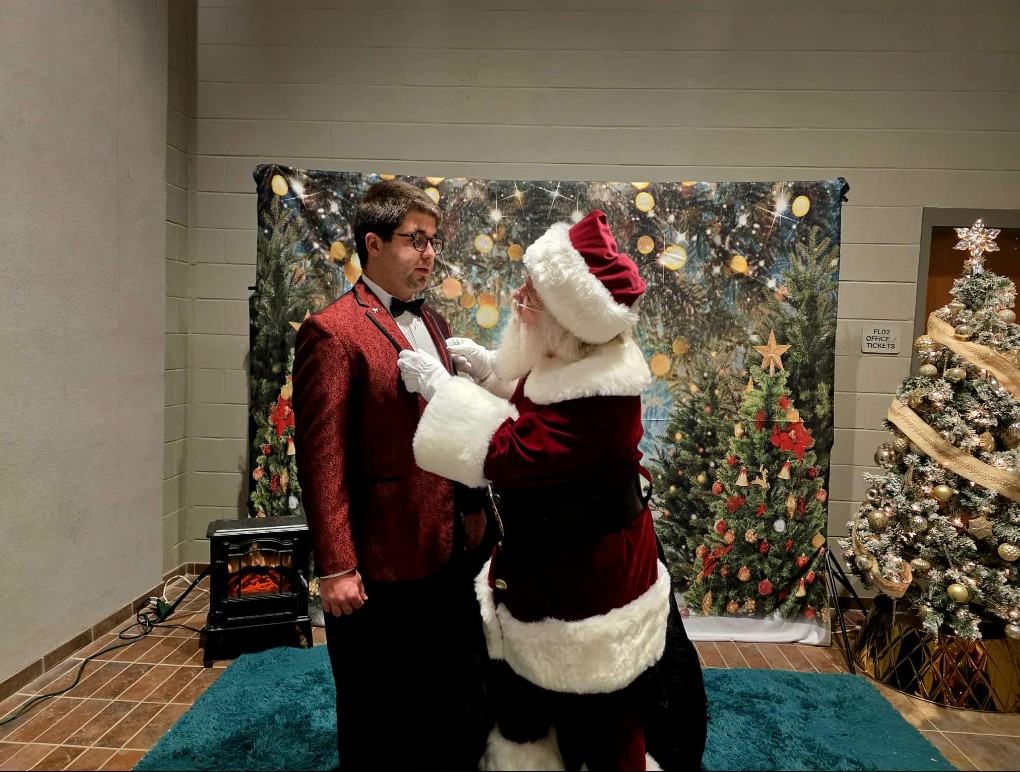
Black lapels frame the line of the coat, and a bow tie completes a look that gives him a classic, conductor-like silhouette. He holds himself with a relaxed posture. Students approach him without hesitation. Santa, standing near a decorated backdrop, reaches over at one point to adjust Weinstein’s bow tie, and Weinstein accepts the gesture with a lopsided smile, a shared moment between two old friends. He appears to take the work seriously but not himself, the perfect balance for a high-school band instructor.
Music as a Gift
Onstage, his stance shifts into focus. His arms rise, his shoulders square, and the ensemble locks onto him. When Weinstein steps to the microphone, he offers a clear purpose for the night. “We want to bring joy to the Habersham community,” he tells the audience. “I was just telling the students that the two most important things we can give anyone—adults and kids, anyone—is hope and joy—and that’s what we want to share with everyone this Christmas season.” His tone sets the direction for the program, which favors music that carries energy, real warmth, and a sense of unity.
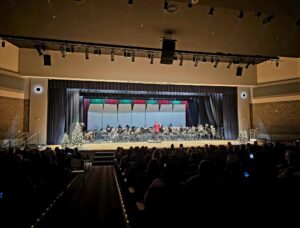
The message lands in a room filled with parents, siblings, and supporters, many of whom have followed these students for years. The band begins with Frank Ticheli’s Joy, a piece that builds on bright lines and unfolding harmonies. It moves forward with confidence and clarity. Ticheli wrote the work in 2005 with an ear for color, and the ensemble uses that palette to paint a picture in the style of Currier & Ives. The piece delivers a clear burst of sound that aligns with Weinstein’s aim and sets a tone for a program that treats music, in the spirit of Little Drummer Boy, as an offering.
In the audience, families speak about the players with affection and pride. Tommy Martin, an animated younger brother, waits for his sister, Morgan Hissam, to take her place on stage. Hissam plays piccolo and flute. Martin gives his review of the evening with the single word: “Good.”
The Symphonic Band leads the first half of the performance. The Wind Ensemble follows. The ensemble includes upperclassmen who fill the stage with a larger sound and tight coordination. Between pieces, Weinstein offers remarks that give greater meaning to the selections. Before Sleigh Ride, he says, “It isn’t Christmas unless we hear Sleigh Ride.” The audience responds with recognition and a short wave of laughter. The whip crack of slapsticks and the beat that suggests the clatter of hooves carry the room through the familiar tune.
Later, he turns to Emmanuel Variants, composed by Robert Foster in 1989. Foster works with the structure of O Come, O Come, Emmanuel to build a sequence of shifting textures. The hymn enters with a low, solemn voice and lifts as the winds add layers. The brass holds the ground. The clarinets and flutes move through the air above it, and the ensemble finds a balance that fits the space. The piece suits a wind ensemble. It asks for control, unity, and patience, and the players meet it with discipline.
Weinstein dedicates this performance of Emmanuel Variants to his pastor, who suffered a heart attack the day before. The room stills. His voice holds steady, but the weight of the moment sits on his intentionally stoic expression. In that context, Foster’s writing takes on greater depth. The music opens like a plea, moves through tension, and resolves with a sense of resilience. After the last note, the auditorium remains quiet for a beat longer than usual before bursting into emphatic applause.
The concert closes with a Christmas sing-along. The director turns to the audience and asks them to join the students for four familiar songs: Jingle Bells, Deck the Halls, Silent Night, and We Wish You a Merry Christmas. Families rise to their feet and sing with gusto as each piece moves forward, some snapping photos, some leaning together to share the small, annual ritual of singing in public, and small children absolutely grooving to the beat.
Support for the Band
Behind the scenes, the band relies on a network of parents, sponsors, and supporters who keep the program moving. Amanda Crawford attends from Habersham Candle, which partnered with the school to sell candles in the lobby. Sherry Adams serves as the Band Booster Club treasurer, and Becky Lommax, a steady presence within the booster leadership, helps organize the work that keeps needs met. These volunteers stand in the lobby after the show while students gather to take photos with families and friends.
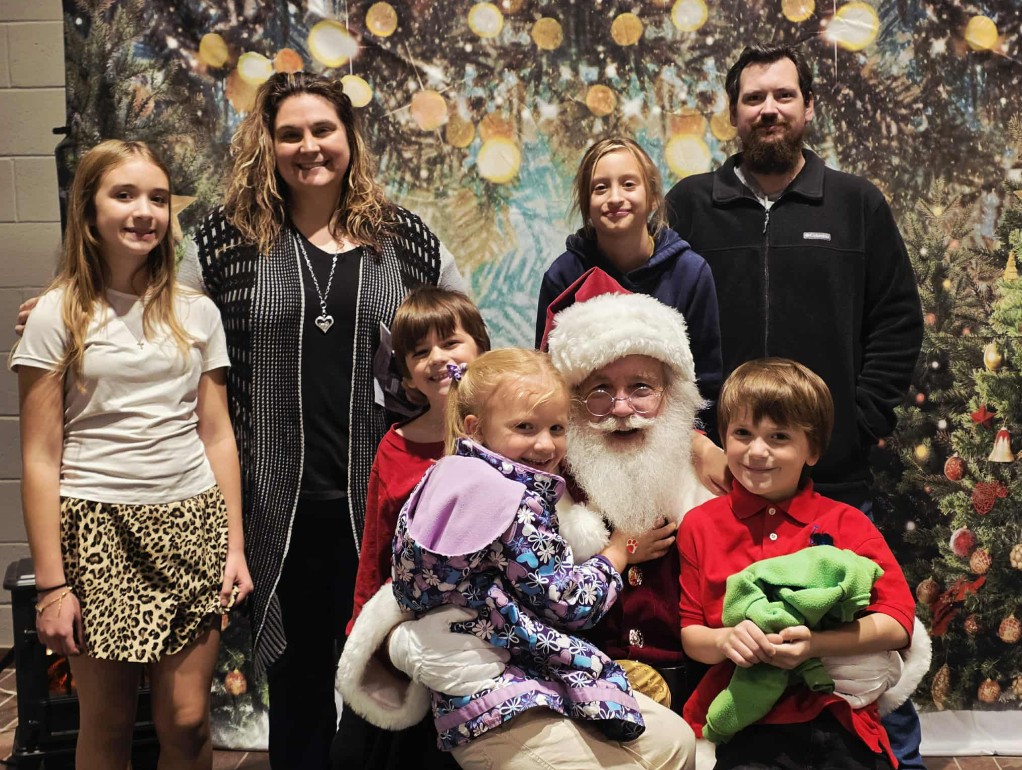
Old Saint Nick himself joined the helpers of the Habersham Central High School band. He agreed to assist the concert for his friend Jacob Weinstein, taking his place beside a decorated backdrop set in a corner of the performing arts center for photographs. A joyful family of eight gathered around the visiting celebrity for a group photo before taking their seats in the auditorium to support their daughter, Madyson Tilley, who played the French horn.
In a season built on tradition, the Habersham Central High School band offers one that rests on the discipline of its students and the leadership of a director who believes music can lift the spirit. The idea echoes the figure at the center of The Little Drummer Boy, who brings what he has and offers it. Weinstein’s words return as the audience clears the aisles and hugs their children: hope and joy.